Thursday, November 3, 2016

Bonaire to SXM

Ready for 485nm 050deg to St Maarten..
Had day of wind reversal here, and probably one more tomorrow, so leaving now, knowing Mercedes has to do it until wind picks up fro EastSouthEast late Thursday/early Friday.
Something 14 knts, hopefully spinnaker can go on, and if we make 5 knts average should be there Sunday late..

Looks now that wind will run out early Monday morning, so might just make it with the wind, otherwise could take some more time...

Sad to leave the Angelfish, they are nice..  Normally shy animals, but now I think they recognize my red swimming trunks because now a day's they come very close to look for where the bread is, even if I have none..
Really nice...


Cheers

Han

Monday, October 10, 2016

Feeding the (Angel) fish...

The normally shy fish keep their distance, but with a bit of bread even the Angelfish go berserk, then even the Angel fish really bump in to me like I'm not there..

To good...


Tuesday, October 4, 2016

4 oct Punt4kant Bonaire, swell... and our boats have no problems

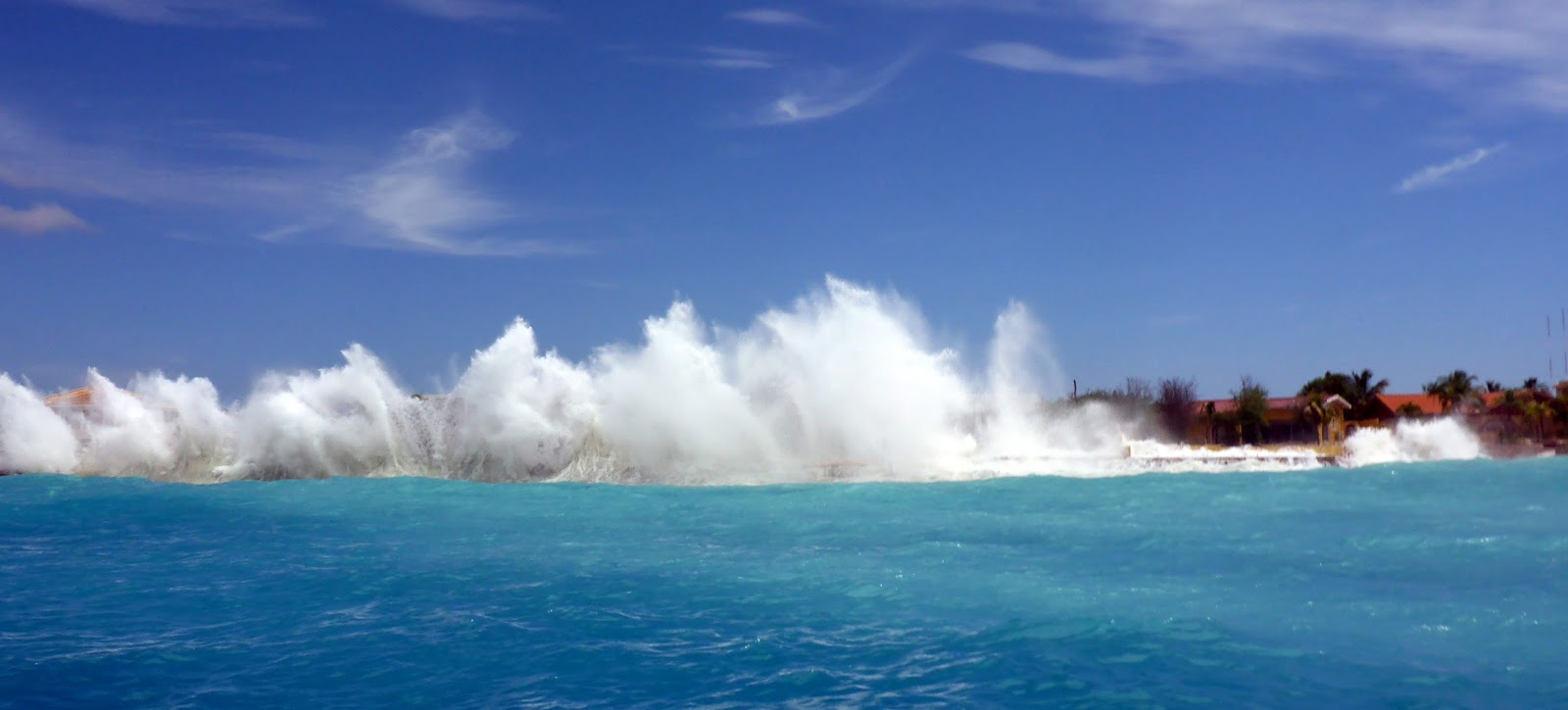
We went out with the dinghy today (Tuesday) to take some pictures of swell smashing into coastline..  Water is flat until very close to the coast and then..  boom


 left to right..  Sailing Yachts  Kim and the Condor..

Picture taken last week before 'Matthew' came by, everyone has gone into Harbor or to Curacao except for the Condor and other Dutch boat..  We had no problems, and even maximum wind we had was 13 knots..
Just found out that today also the swell is runni9ng into the harbor where the boats still are, so a lot are being flushed out today.. the swell breaks everything apparently..  funny, we still have no problems out here...

below normal situation as it is now again full with boats on moorings.. 17 oct 2016


 Swell on Punt4kant seen from Condor...

Wednesday, September 14, 2016

West... Grenada - Bonaire..

Grenada was very rolly.. so moving west now..
385nm down wind..
no hurry,
time to catch some Yellow fin Tuna I hope..

Yellowfins are able to escape most predators, because unlike most fish, tuna are warm-blooded, and their warm muscles make them extremely strong swimmers, with yellowfin tuna reaching "speeds of up to 50 miles per hour"

Slow trip, not much wind but very relaxing.. 
to slow to catch nice fish, I gave up after 1 Dolphin/MahiMahi..

 Foiling kiter enjoying himself at Bonaire in the middle of a lot of dolphins
  Of course I arrive just after dark..  the full moon showed itself a few minutes after I found a mooring near Kareltjes bar at Kralendijk.

Monday, August 29, 2016

South.. SXM to Grenada

Time to sail a bit with the Condor..

From St Maarten South to Grenada..  355nm..
Nice Easterly 15-20knots.. perfect

Cheers


 Unbelievable fast this time..  Left Monday 1800 and arrived Wednesday 2200..  355nm in 52 hours..   6.83knts average..  Nights pitch black, saw no other boats at all, long times 8knts+ with my under 12m Condor..  23knots wind max, full jib and main, about 60 to the wind..

Very, very nice..

Of coarse..  All also resulted in arriving at anchorage at pitch black time of 2200...  nice
I thought arriving 0600 the next morning earliest..

 Sophie has a bigger pot to stand in and survived again, now almost 5 years on board..


 This is how one anchors here at St George Grenada..  The 'floor' is old coral with tiny layer of sand..  So anchor has to find a rock to set its self behind..
 So you better check it in the water..


Cheers


Friday, May 20, 2016

Shark

Uhhh,
what is this under me?
A shark?
a young whale shark maybe?.... with company btw..


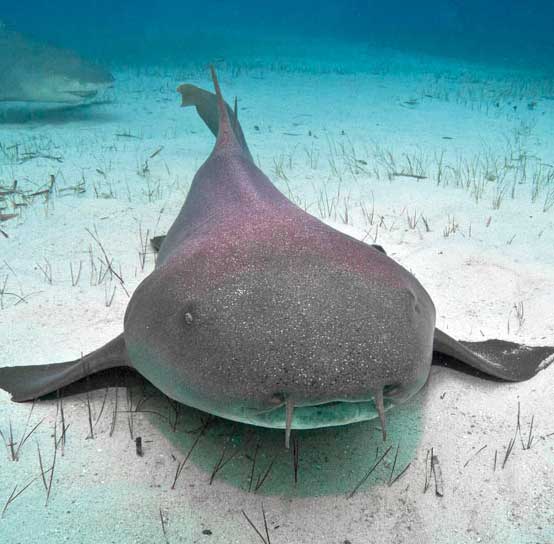
It's a harmless Nurse shark..

The nurse shark is light yellowish-brown to dark brown, sometimes have small dark spots. It has a flattened body and a broad, rounded head with two conspicuous barbels between the nostrils, which are used to help find food. The mouth is filled with rows of small, serrated teeth for crushing hard-shelled prey.
Generally slow and sluggish, nurse sharks spend much of their time resting on the ocean's bottom. Unlike many sharks, this species is non-migratory—the nurse shark adapts to cold by becoming even less active!
Nurse sharks reach sexual maturity at 18 years for males, and 20 to 22 years for females. Females produce a litter of about 20 to 25 pups every other year.

 (picture from internet)

Did You Know?

The nurse shark can use its large front fins to “walk” along the ocean floor.

Diet

Although they may appear sluggish, nurse sharks slurp up benthic, or bottom-dwelling, organisms in their bellows-like mouths with amazing speed. They feed mostly at night on spiny lobsters and other crustaceans, small stingrays, sea urchins, squid and bony fishes.

Size

Female nurse sharks, averaging 7.5 to 9 feet in length and 165 to 230 pounds, are slightly larger than males.

Range

Common in tropical and subtropical coastal waters on both sides of North America, nurse sharks often inhabit reefs and rest during the day on sandy bottoms or in caves and crevices. They show a strong preference for certain resting sites, repeatedly returning to the same spot after their nocturnal forages.

Predators

No species is known to regularly prey on nurse sharks, although they have been found in the stomach contents of lemon, tiger, bull and great hammerhead sharks.

======


Nurse Sharks – a bottom dweller

Description

nurse shark diving bahamas
Nurse shark in the sand
Nurse shark, Ginglymostoma cirratum, from the Ginglymostomatidae family. Its body is yellow-brown to gray-brown, with or without small dark spots and obscure dorsal saddle markings. Mouth is set forward of eyes and is relatively high up on the head – maintaining a more forward position. Noticeable barbells are present, along with nasoral grooves (though there are no perinasal grooves). Spiracles are minute. Dorsal fins are broad and rounded, with the first dorsal being considerably larger than the second. Dorsal fins are set relatively far back along the ventral surface. The upper lobe of the caudal fin is considerably longer than the lower lobe. The caudal fin itself comprises roughly one quarter of the overall body length.
They can get quite large with a length of up to 4.5 meters (15ft) as adults. These large creatures reach weights as high as 150 kilograms (330 pounds). Typically, they live to between 25 and 35 years of age.
Unlike most sharks, which require constant motion to move water over their gills and maintain a sufficient internal blood pressure, the nurse shark often remains motionless along the bottom – actively pumping water over its gills through the continual opening and closing of its mouth.

Location

They prefer warm seas and range through the Atlantic and east Pacific. This species is often found along reef sites, within mangrove channels, and on sand or sea grass flats. They are often observed at depths of a meter or less within the intertidal zone, though they are known to range down to depths of at least 12 meters.

Diving with Nurse sharks

Nurse sharks have long elegant lines, and, since they move sluggishly, you don’t have to worry about scaring them away. Nurse sharks are nocturnal animals, spending the day in large inactive groups of up to 40 individuals. They can be a special sight when encountered in such groups. Nurse sharks are generally considered to be a docile shark species. Virtually every tallied attack has been provoked, so unless one tries to pull its tail, you will have a safe close encounter, should you meet one.

Wednesday, May 18, 2016

Water temp Atlantic.. 15 May 2015 vs 2016

2015 gave no storms or Hurricanes on our side of the Carib..
That was due to ..
Atlantic water under 28C
Shear winds.. tops of potential Storms/Hurricanes was cut of so it could not build bigger
AND everything which was there turned North before it got to us..
etc
2015 May 15th
 2016 May 15th
We see water is warmer then last year...
Time will tell what shit...
btw a few month ago I read somewhere water was colder, due to mixing with colder water of melting N-pole..


How it works?
Over the Sahara there will be a sort of chain belt pooping out the start of depressions regularly and if Atlantic water is over 28C, and if no sand is blown with it from Sahara, and not to humid, and no shearing of the top (That comes from the west (Pacific) and is supported by El Nino) ..

So first few month of hurricane season most chance is shit will go over south of our Carib side, so end of July/Aug I will go south from SXM to avoid that kind of shit when it comes higher..

Theory of course